WHOLE is a five-letter memory aid for applying any method with integrity, so a project doesn’t drift from what it set out to achieve. Each letter below has methods to try with your team or on your next project, and further reading.
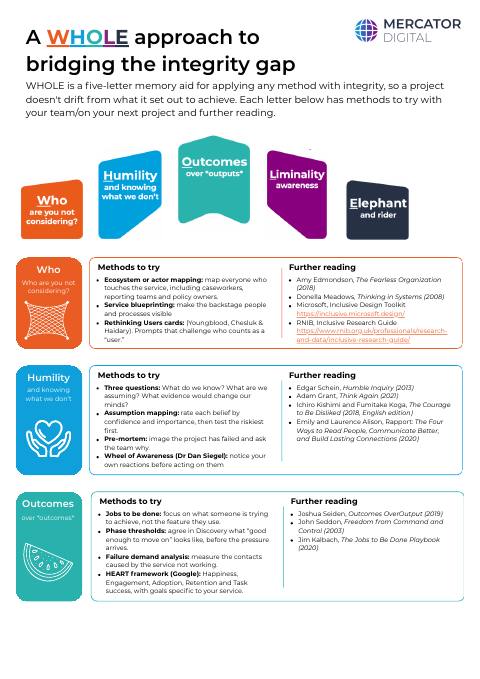
- Who are you not considering?
- Humility and knowing what we don’t
- Outcomes over outputs
- Liminality awareness
- Elephant and rider
Who are you not considering?
Methods to try
- Ecosystem or actor mapping: map everyone who touches the service, including caseworkers, reporting teams and policy owners.
- Service blueprinting: make the backstage people and processes visible.
- Rethinking Users cards (Youngblood, Chesluk & Haidary): prompts that challenge who counts as a “user”.
Further reading
- Amy Edmondson, The Fearless Organization (2018)
- Donella Meadows, Thinking in Systems (2008)
- Microsoft, Inclusive Design Toolkit
- RNIB, Inclusive Research Guide
Humility and knowing what we don’t
Methods to try
- Three questions: What do we know? What are we assuming? What evidence would change our minds?
- Assumption mapping: rate each belief by confidence and importance, then test the riskiest first.
- Pre-mortem: imagine the project has failed and ask the team why.
- Wheel of Awareness (Dr Dan Siegel): notice your own reactions before acting on them.
Further reading
- Edgar Schein, Humble Inquiry (2013)
- Adam Grant, Think Again (2021)
- Ichiro Kishimi and Fumitake Koga, The Courage to Be Disliked (2018, English edition)
- Emily and Laurence Alison, Rapport: The Four Ways to Read People, Communicate Better, and Build Lasting Connections (2020)
Outcomes over outputs
Methods to try
- Jobs to be done: focus on what someone is trying to achieve, not the feature they use.
- Phase thresholds: agree in Discovery what “good enough to move on” looks like, before the pressure arrives.
- Failure demand analysis: measure the contacts caused by the service not working.
- HEART framework (Google): Happiness, Engagement, Adoption, Retention and Task success, with goals specific to your service.
Further reading
- Joshua Seiden, Outcomes Over Output (2019)
- John Seddon, Freedom from Command and Control (2003)
- Jim Kalbach, The Jobs to Be Done Playbook (2020)
Liminality awareness
Methods to try
- Bridges’ Transition Model: the model outlines three key stages that individuals experience during transitions; the neutral zone is the in-between.
- Cynefin framework: work out whether a situation is clear, complicated, complex or chaotic, and act to match.
- Decision logs: record what was decided, when and why, so changing plans don’t become blame.
Further reading
- Arnold van Gennep, The Rites of Passage (1909)
- Dave Snowden and Mary Boone, “A Leader’s Framework for Decision Making”, Harvard Business Review (2007)
- David Gray, Liminal Thinking: Create the Change You Want by Changing the Way You Think (2016)
Elephant and rider
Methods to try
- Direct the rider, motivate the elephant, shape the path: the Heath brothers’ practical version of Haidt’s metaphor.
- EAST framework (Behavioural Insights Team): make the desired behaviour Easy, Attractive, Social and Timely.
- Giving Voice to Values: rehearse how you’ll speak up before the moment arrives.
Further reading
- Daniel Kahneman, Thinking, Fast and Slow (2011)
- Chip and Dan Heath, Switch (2010)
- Mary Gentile, Giving Voice to Values (2010)
Referenced in the talk
- Diane Vaughan, The Challenger Launch Decision (1996): normalisation of deviance
- ISO 9241-210:2019, Human-centred design for interactive systems
- Tacoma Narrows Bridge: “Ethical Issues from the Tacoma Narrows Bridge” (CED Engineering)
- Jonathan Haidt, The Happiness Hypothesis (2006) and The Righteous Mind (2012)
About Kathy
Kathy Neuss, Head of Research, Mercator Digital
- Email: Kathren.Neuss@mercator.group